An aluminum fence gives homeowners a rust-proof, low-maintenance boundary that pairs the classic look of wrought iron with modern engineering and decades of dependable performance. If you have been weighing your options for a new perimeter, pool enclosure, or decorative border, aluminum fencing keeps rising to the top of the list for good reason. This guide breaks down the real advantages, honest costs, and the practical details you need before you commit.
- Long-term value: You will see how aluminum fencing lasts 40 to 70 years with almost no upkeep, which offsets its higher upfront price.
- Real cost ranges: You will get concrete numbers, from $30 to $50 per linear foot installed, so you can budget with confidence.
- Buying confidence: You will learn the six standout benefits, common questions, and what to look for in a professional installer.
What Is an Aluminum Fence and How Does It Work?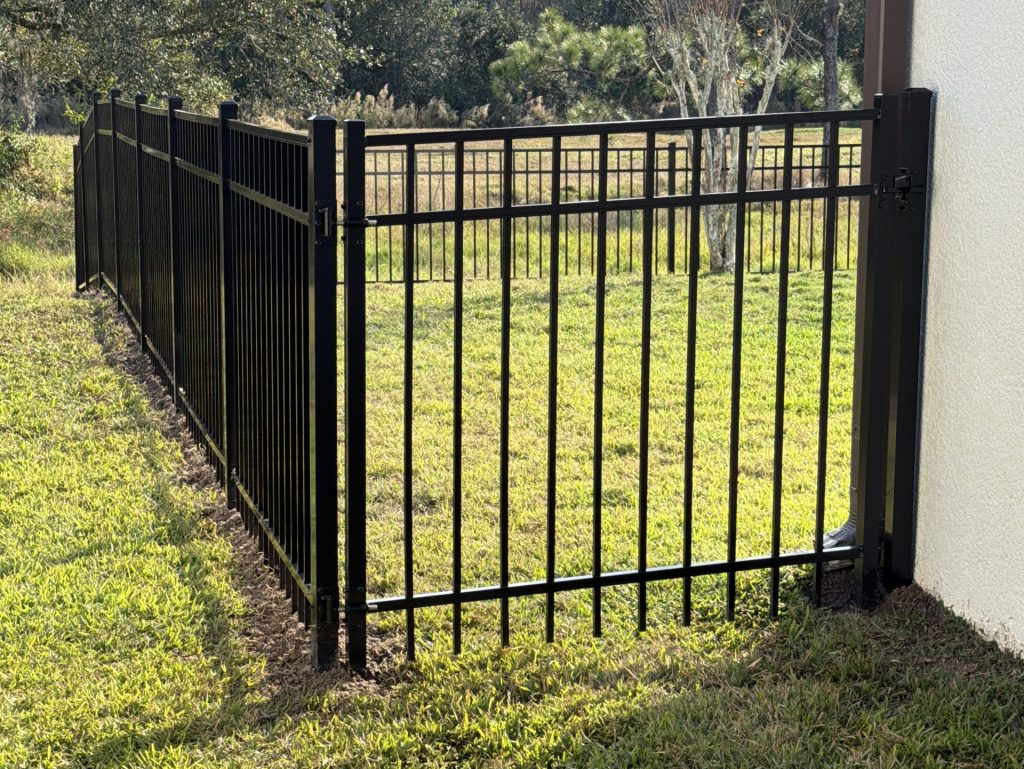
An aluminum fence is a rust-resistant metal fencing system built from powder-coated aluminum alloy panels, posts, and pickets that mimic the ornamental style of iron without the weight or corrosion. It works by combining a naturally corrosion-fighting metal with a baked-on finish that shields the surface from weather, salt, and UV rays.
Why Does Aluminum Resist Rust So Well?
Aluminum resists rust because the metal forms a natural protective oxide layer the moment it meets air, sealing the surface against moisture and corrosion. Most residential systems are built from alloys such as 6005-T5 or 6063-T6, then coated with a powder finish that adds a second barrier against fading and chipping. This dual protection is why aluminum outperforms steel and wrought iron in humid, rainy, and coastal settings where ordinary metals corrode within a few years. The result is a fence that holds its color and structure with nothing more than the occasional rinse.
- Natural oxide layer: Aluminum self-heals microscopic scratches by reforming its protective coating on contact with air.
- Powder-coat finish: A baked-on color layer resists fading for 20 years or more in black, bronze, or white.
- Coastal friendly: Salt air that eats through steel has little effect on properly finished aluminum.
- No sacrificial maintenance: Unlike iron, there is no annual sanding or repainting to prevent rust.
How Long Does an Aluminum Fence Last?
An aluminum fence typically lasts 40 to 70 years, far outlasting wood, which usually needs replacement every 15 to 30 years. Because the metal will not rot, warp, or attract insects, the main variable in its lifespan is the quality of the powder coating rather than the metal itself. Homeowners who choose professional-grade panels from established manufacturers often see their fencing outlive the roof and siding installed around the same time. That longevity is a major reason aluminum earns strong resale and curb-appeal value over the decades you own your home.
- Decades of service: Quality residential aluminum commonly reaches 50-plus years in place.
- No rot or pests: Termites and moisture that destroy wood have no effect on metal.
- Stable in weather swings: Aluminum does not swell or shrink through freeze-thaw cycles.
- Warranty backing: Many manufacturers offer limited lifetime warranties on the finish.
6 Top Benefits of Choosing an Aluminum Fence
The advantages of aluminum fencing go well beyond looks, touching durability, safety, and your long-term budget. Below are the six benefits homeowners mention most when they explain why they chose aluminum over wood, vinyl, or iron.
1. Exceptional Durability With Virtually No Maintenance
Aluminum fencing delivers one of the best durability-to-effort ratios of any fencing material, resisting rust, rot, and insect damage while asking for little more than an occasional cleaning. The powder-coated finish holds up against rain, hail, and intense sun, and the metal itself carries a minimum ultimate strength of roughly 35,000 pounds per square inch, meaning it takes tremendous force to permanently dent a properly installed panel. For busy homeowners, that translates to a fence that looks new for decades without staining, sealing, or replacing boards, saving both weekends and repair dollars year after year.
- Rust-proof performance: The metal will not corrode the way steel or iron does over time.
- Low upkeep: Routine care is simply soap, water, and a garden hose a couple times a year.
- Impact resistant: The alloy withstands high wind, heavy rain, and everyday wear.
- Fade resistant: Powder coating keeps the color consistent for 20 years or longer.
2. Timeless Curb Appeal and Home Value
Aluminum fencing offers the elegant, wrought-iron look that boosts curb appeal and property value without the weight, rust, or cost of real iron. Its clean vertical pickets and optional decorative finials complement everything from traditional colonials to sleek modern builds, and color choices like black, bronze, and white let the fence blend into or accent your landscaping. Because aluminum keeps its finish for decades, that first-impression appeal does not fade, which matters when appraisers and buyers evaluate your home. A well-chosen fence line frames a yard the way a good frame flatters a painting.
- Ornamental styling: Picket, spear-top, and flat-top designs echo classic ironwork.
- Color options: Powder-coated black, bronze, and white suit most exteriors.
- Custom heights: Common residential heights run from 36 to 72 inches.
- Lasting first impression: The finish stays sharp, protecting resale value.
3. Safety and Security for Pools, Pets, and Kids
Aluminum fencing provides a secure, code-friendly barrier that is especially popular for enclosing pools, containing pets, and keeping children safely inside the yard. Many aluminum systems are designed to meet residential pool-barrier codes, with picket spacing and heights that discourage climbing and prevent small children from slipping through. The rigid metal construction is far harder to breach than lightweight wood or chain link, giving families real peace of mind. Because the pickets are narrow, the fence secures your space without blocking sight lines across the yard.
- Pool-code compatible: Many designs meet common residential barrier requirements.
- Pet containment: Tight picket spacing keeps dogs and cats safely inside.
- Climb resistant: Smooth vertical pickets offer few footholds for children.
- Clear sight lines: Open styling lets you watch the yard and pool at a glance.
4. Works Beautifully on Slopes and Uneven Ground
Aluminum fencing adapts to hills and uneven terrain through rackable panels that follow the slope of your land without leaving awkward gaps. Rackable systems let each panel pivot at the brackets so the top rail follows the grade, avoiding the stair-stepped gaps that plague rigid wood and vinyl sections. This creates a clean, continuous top line and closes the ground gaps that pets and small children could otherwise squeeze through. For yards with dips, rises, or rolling landscaping, this flexibility is a practical advantage that other materials struggle to match.
- Rackable panels: Sections flex to follow slopes without custom cutting.
- No stair-step gaps: The design avoids the openings that hurt security and looks.
- Seamless top line: The fence traces the land for a polished, finished appearance.
- Fewer custom parts: Adjustability reduces the need for special-order pieces.
5. Strong Long-Term Value Despite a Higher Upfront Cost
Aluminum fencing costs more to install than wood or chain link at the start, but its decades-long lifespan and near-zero maintenance make it one of the most cost-effective choices over time. When you factor in that wood may need staining every few years and full replacement within 15 to 30 years, the aluminum option that lasts 40 to 70 years often wins on total cost of ownership. There are no boards to replace, no rust to treat, and no repainting bills, so the money you save on upkeep steadily offsets the initial investment. For homeowners planning to stay put, that math is hard to beat.
- Lower lifetime cost: Minimal upkeep offsets the higher purchase price over the years.
- No replacement cycle: You avoid the repeated teardown costs common with wood.
- Predictable budget: No surprise repair bills for rust or rot.
- Resale payoff: A finish that lasts protects the value you paid for.
6. An Eco-Friendly, Recyclable Choice
Aluminum fencing is one of the greenest fencing materials available because aluminum is infinitely recyclable without losing quality. Homeowners who care about sustainability appreciate that choosing aluminum supports a material with an unusually efficient recycling loop, since remelting scrap uses only about five percent of the energy needed to produce new metal. That environmental efficiency, paired with the fence’s own long life, means less waste heading to landfills compared with materials that must be torn out and replaced every decade or two. A durable, recyclable fence is a quiet win for both your yard and the planet.
A comprehensive industry mass flow analysis found that nearly 75 percent of all aluminum ever produced is still in use today, a testament to the metal’s durability and recyclability that directly benefits long-lasting products like fencing.
- Infinitely recyclable: Aluminum can be recycled repeatedly without degrading.
- Energy efficient: Recycling uses roughly 95 percent less energy than new production.
- Less landfill waste: A 40-to-70-year lifespan means far fewer replacements.
- Responsible choice: The material supports a genuine circular-economy loop.
How Much Does an Aluminum Fence Cost?
Aluminum fence pricing depends on height, style grade, gates, and terrain, but most residential installations fall within a predictable range. The two sentences that follow give you the numbers most homeowners search for before requesting an estimate.
What Is the Average Cost Per Linear Foot?
The average installed cost of an aluminum fence runs roughly $30 to $50 per linear foot for standard residential-grade systems. Pricing climbs toward the higher end when you select taller panels, commercial-grade thickness, decorative finials, or additional gates, and it can rise further on sloped or rocky ground that complicates post setting. To put that in perspective, enclosing a modest backyard of around 150 linear feet typically lands somewhere in the low-to-mid four figures before gates and upgrades. Because every yard is different, a walk-through measurement is the only way to pin down an accurate figure for your property.
- Standard range: Expect about $30 to $50 per linear foot installed.
- Grade matters: Residential, commercial, and industrial grades carry different prices.
- Gates add cost: Each walk or drive gate increases the total.
- Site conditions: Slopes and rocky soil can raise labor costs.
What Factors Change Your Final Price?
Your final aluminum fence price is shaped by the linear footage, panel height, number of gates, style complexity, and how challenging your terrain is to work with. Taller and thicker panels use more material, ornate designs cost more than simple flat-top styles, and each gate adds hardware and labor to the total. Terrain plays a quiet but real role, since sloped, rocky, or root-filled ground takes longer to dig and set posts correctly. Getting a detailed, itemized estimate helps you see exactly where your dollars go and where you might adjust to fit your budget.
- Linear footage: More perimeter means more panels and posts.
- Height and grade: Taller, heavier-duty panels cost more per foot.
- Number of gates: Walk and drive gates each add to the price.
- Terrain difficulty: Hard or sloped ground increases installation labor.
Frequently Asked Questions
How much does an aluminum fence cost to install?
Most residential aluminum fences cost between $30 and $50 per linear foot installed. The final number depends on panel height, style grade, the number of gates, and how difficult your terrain is to work with. For an accurate figure, request an on-site measurement and itemized estimate.
How long does an aluminum fence installation take?
A typical residential aluminum fence is installed in one to two days once materials are on site and any permits are approved. Larger properties, difficult terrain, or multiple gates can extend that timeline slightly. Your installer can give you a firm schedule after measuring the yard.
Can I install an aluminum fence myself?
Aluminum fencing is more DIY-friendly than many materials because panels arrive pre-assembled with the needed hardware, but professional installation ensures proper post depth, level lines, and code compliance. Mistakes in post setting or pool-barrier spacing can be costly to fix and may void manufacturer warranties. Professional installation also keeps factory warranties intact and adds a workmanship guarantee.
How much maintenance does an aluminum fence need?
Aluminum fencing needs very little maintenance, usually just an occasional wash with mild soap, water, and a garden hose two or three times a year. There is no staining, sealing, sanding, or repainting required because the metal will not rust and the powder-coat finish resists fading. This makes it one of the lowest-upkeep fencing options available.
Do I need a permit or licensing for an aluminum fence?
Many municipalities require a permit for a new fence, and pool enclosures almost always must meet specific barrier codes. Requirements vary by city and neighborhood, and homeowners associations may add their own rules on height and style. A professional installer familiar with local codes can handle permitting and confirm your fence meets every requirement.
Is aluminum fencing better than wrought iron?
For most homeowners, aluminum offers the classic iron look without the rust, weight, or constant maintenance that real wrought iron demands. Iron can last a very long time but requires regular painting to prevent corrosion, while aluminum keeps its finish for decades with almost no effort. Aluminum is also lighter, easier to install, and typically more affordable to maintain.
Why Fence Direct Is the Right Choice for Your Aluminum Fence
When you are considering an aluminum fence, you want a team that understands both the product and the local conditions your fence will face, and that is exactly what Fence Direct delivers. Our crews install professional-grade, powder-coated aluminum systems designed to resist rust, hold their finish, and follow the natural grade of your yard for a clean, secure result that lasts for decades. Every new fence installation is backed by a two-year workmanship warranty on top of the manufacturer coverage, so you can invest with genuine confidence. We take the time to measure carefully, explain your style and cost options in plain language, and handle the details that protect your warranty and your property.
If you are ready to explore aluminum fencing for your home, reach out to Fence Direct for expert guidance and a free estimate. We return every call within 24 business hours, so getting real numbers for your aluminum fence is quick and pressure-free. Contact us today and let our team help you choose the durable, low-maintenance aluminum fence that fits your yard and your budget.